
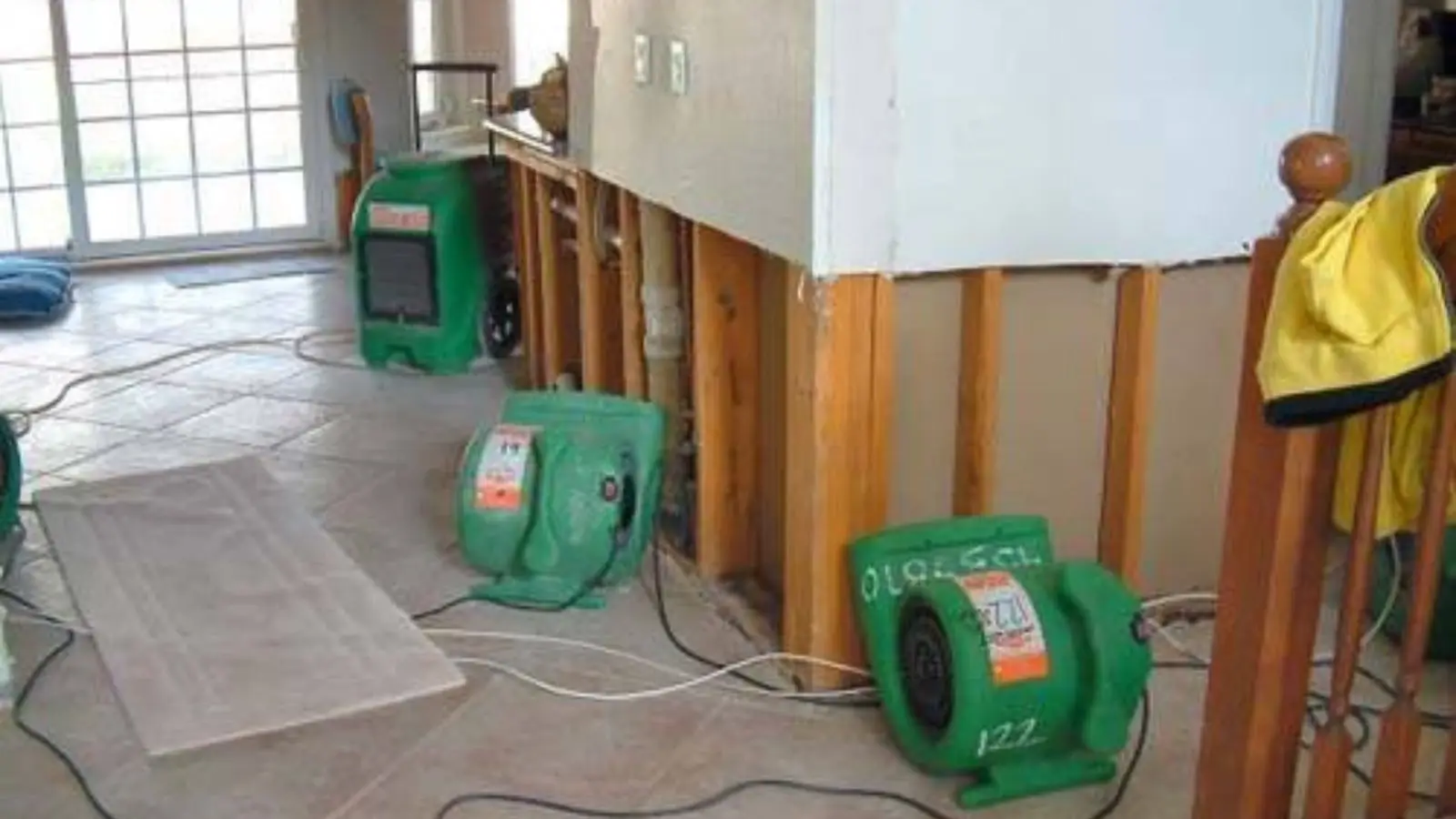
What a water damage drying company actually does
Drying is the part of restoration where wet building materials are brought back to normal moisture content. Nothing about it is cosmetic. Wet framing, subfloor and drywall are measured, then the air around them is managed until readings fall into range.
Companies that follow ANSI/IICRC S500, the published standard for water damage restoration, work from moisture readings and not from guesses. A fair screening question is whether a company's crews follow S500, along with a request to see logs from a past job with names removed.
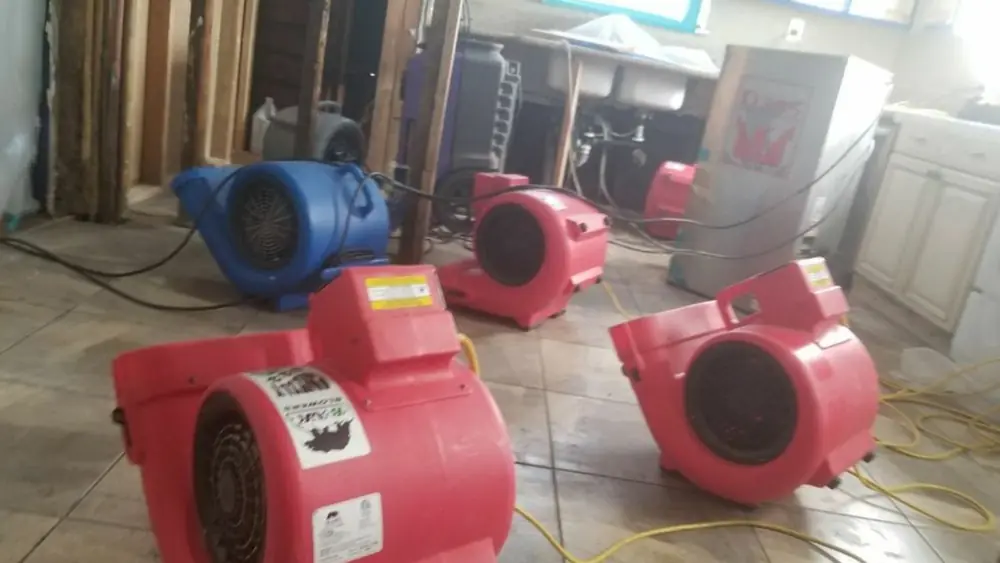
The equipment has simple jobs. Air movers keep dry air moving over wet surfaces so moisture leaves them. LGR dehumidifiers pull that moisture out of the air so it does not settle back into the walls. Truck-mounted or portable extraction units remove standing water before any of that begins.
How a professional drying job unfolds
Inspect and map
A technician uses a moisture meter and thermal imaging camera to find where water traveled, including behind baseboards and under cabinets.
Classify the water
The water is rated Category 1, 2 or 3 and the loss is given a class, which sets what can be dried and what must be removed.
Extract and remove
Standing water is pumped out. Saturated carpet pad, soft baseboard and damaged drywall are cut away where they cannot be dried in place.
Set equipment
Air movers and dehumidifiers go in according to room volume and wet surface area, not a one-size count.
Monitor daily
Readings are taken and written in a drying log, equipment is moved or removed, and the job ends only when materials reach target readings.
Want a scope explained before work starts?
Call the 24/7 line. We explain how the scope and price are set, and what an assessment includes, before any equipment goes in.
Hiring a drying crew for a Reseda house, condo or apartment
The planning department's housing count for this part of the Valley is 37,825 units, with 55.8 percent single-unit and 42.9 percent multi-unit. Nearly 43 percent multi-unit means that many water losses involve a neighbor, a shared wall or a building owner. Before drying starts in a condo or apartment, find out who must approve access to the unit above or below.
The same profile shows the largest share of units, 39.2 percent, built in the 1950s. Older construction can hide moisture in wall cavities and under layered flooring, so ask the crew how they test before opening a wall and how they handle older materials.
Two CSLB rules work as a screen before you sign. A contractor license applies once a job needs a permit or reaches $1,000 in labor and materials, and the board's deposit advice is a written contract with a small down payment.
Sources: LA City Planning, Reseda and West Van Nuys demographic profile, CSLB, what kind of contractor do you need, CSLB disaster help center, EPA, Brief guide to mold, moisture and your home, California Department of Insurance, residential property claims
How long drying takes depends on four things
What was wet
Carpet and drywall release moisture quickly. Hardwood, plaster and dense framing hold it much longer.
How much water
A supply-line drip into one wall and a full-room flood are different jobs from the first reading.
Water category
Contaminated water adds removal and cleaning, which changes both the timeline and the cost.
Indoor conditions
Humidity, temperature and how quickly extraction started all change the pace of drying.
Many jobs take several days, and crews decide by readings instead of a calendar. Because EPA wants wet materials dry in one to two days to stop mold, starting early matters more than any equipment brand.
What to ask a drying company before you say yes
| Ask | Why it matters | Reasonable answer |
|---|---|---|
| Do you map moisture before setting equipment? | Without a map, the crew cannot know where the water went | Yes, with a meter and thermal camera, and notes on a sketch |
| Will I get a drying log? | Dated readings prove the structure reached dry | Yes, daily readings, shared on request |
| Do your crews work to S500? | S500 is the published standard for this work | A plain yes, and a description of what that means on site |
| How is the scope set? | A vague scope makes the final bill unpredictable | Written items covering rooms, materials and equipment days |
| What happens if readings stay high? | Extra days change the cost and the plan | The company explains how extension is documented and approved |
How scope and price should be explained before work starts
Callers often ask for a quote first. A fair answer starts with an assessment, since price follows the affected area, the class of loss, the water category, how many days of equipment are needed and what materials must be removed. A number given over the phone without those facts is a guess.
Ask that the scope and price be explained before work begins, and ask for the scope in writing. Check the contractor's license and insurance, and keep any estimates you collect side by side.
If you rent a single dehumidifier from a hardware store, you can help a minor spill, but it will not map moisture, move enough air through walls or document a claim. We do not rent equipment out. Our water mitigation crews bring the gear and run the job.
Cleanup, rebuild and the paper trail
Drying is not the same as cleanup or repair. After the structure is dry, sanitizing, deodorizing and debris removal fall under water damage cleanup, and rebuilding is separate again. A drying company is also not a waterproofing contractor, so it will not seal foundations or stop outside water from entering.
Your insurer will want evidence. Keep photos from day one, the moisture log and every receipt. The California Department of Insurance advises keeping receipts, making temporary repairs and not discarding damaged items until your insurer says so.
Our crews respond to homeowners in Encino and to renters in Winnetka with the same documentation, because the claim file looks the same either way.
Frequently Asked Questions
I live in a Reseda condo and water came from the unit above. Who handles drying?
Usually the building's insurance and the HOA or owner of the source unit are involved, and each has its own process. Document your side first, notify them in writing, and ask the drying company to log readings in your unit separately.
Can I dry the area myself with fans?
Fans help on small, surface-level spills. They do not measure wet walls, and moving air without removing humidity can push moisture elsewhere. For anything beyond a small area, call a crew.
Will the company tell me the price first?
Before any work begins it should tell you how the scope and price were arrived at, and hand you the scope in writing. Call the 24/7 line if you want a company to describe its process.
Does a drying company also do mold work?
Drying prevents the conditions mold needs, but mold removal is a separate job with containment under S520. If mold is already visible, ask about remediation as a separate item.
What if the dehumidifier I rented is not enough?
Small units lower room humidity but do not dry materials inside walls. If readings stay high after a few days, have the structure assessed.
Water still spreading? Call the 24/7 line at (818) 337-2642.